By: Paul Ramage
Some sixty years after, I feel it a duty to tell my tale of unplanned heroism in early 1941.
While enduring and even suffering under RCAF training in Calgary, AB, there was a weekend benefit like no other.
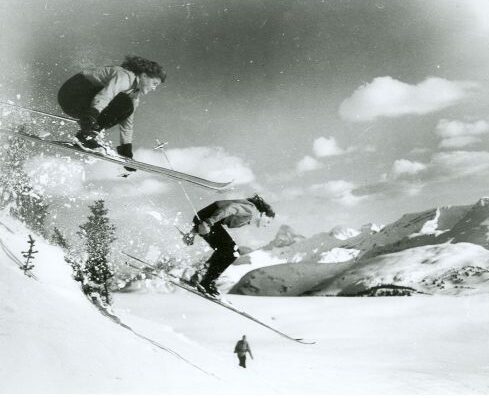
Saturday noon there was a Brewster bus to Banff, with shelter in an air force hostel manned by volunteers, with Sunday morning breakfast, a bus to Mt. Norquay, free rope tow and bus back to Banff, and on to Calgary. All of these benefits for $3.00. A super bargain for an airman earning a wasteful $1.30 per diem. In all of these goodies, Banff residents were wonderful to us. On my first Sunday morning I made my way to the Brewster bus departure area, near the Mount Royal Hotel. While waiting, two local skiers looked at my ski equipment (i.e. Atenhofer skis with steel edges. Kandahar bindings, Pintar boots). All very impressive.
The two young men asked where I was from. Told them Montreal, but I skied in the Laurentians. Next question: “have you competed?”… “Yes, “ I said but did not elaborate because my best effort was in the Taschereau at Tremblant, where I was under four minutes, with the winner, as I recall, under two minutes. My new acquaintances told of a ski competition on Norquay that day, and that they would welcome an eastern competitor. I still recall the names of my new friends: Ted Paris and Bud Gourlay.

The bus trip to Norquay was a short one. We got off behind the chalet, walked around to the front and I saw a wide open hill with a rope tow. It felt like home. I know all about hills because I’d skied hills 60 - 70 – 80, so the one in front of me didn’t look so tough. I asked my new friends where on this hill do you set the course? One of them said, “Not that slope, it’s that mountain, “ and pointed to it. I looked up and up, until I thought the top of Norquay had to be a yard or two from heaven. I said, “that mountain?” “Yup,” they said. “How do you get up there?” I asked. “We climb, and condition, and set the course on the way up.” Next question: “What do you call it?” Reply: “A controlled downhill.” After the war it was called a giant slalom – but never off a cliff.
We skied over and started to climb. All of it sideways in order to tamp down the deep powder snow. The course setter would follow using flagged poles to set wide gates from side to side on the course. The theory being it would control speed. An hour or so later I reached the top and looked down. When I did so, my first impression was that the bottom was behind me. I was then told I would go last. I hoped for darkness before then.
The stopwatch was at the bottom, so the starter on top would let each skier go as a flag signaled from the bottom. No one started until the preceding skier finished. Good idea, I thought. I watched as the twenty local madmen would each “whoop” and take off. Some even made the course to the bottom. I suspect their descendants are now competing in the Calgary Stampede. Finally I was alone on top and couldn’t even remember any survival prayers. I watched the flag drop, heard the starters’ “Go” and started out stemming. I picked up speed, made the first and second pair of gates. On the third I caught a ski on a pole. The ski came off and I started to slide, face first. Slid off the course into deep powder snow. Thought I was drowning. Struggled to get up. Took off the remaining ski, then slid to the bottom as best I could. A wag later mentioned that my first ski set a record but missed some gates!
My survival taught me the enormous difference between a hill and a western mountain. Subsequently I had several great weekends on the Norquay rope tow hill and two glorious ones at Sunshine – a skier’s paradise. Finally, in the controlled downhill race results I was listed as DNF, which has to rank well below DFC.
Editors Note: DFC is a ‘Distinguished Flying Cross’ a medal awarded to officers and Warrant Officers for an act or acts of valour, courage or devotion to duty performed while flying in active operations.